
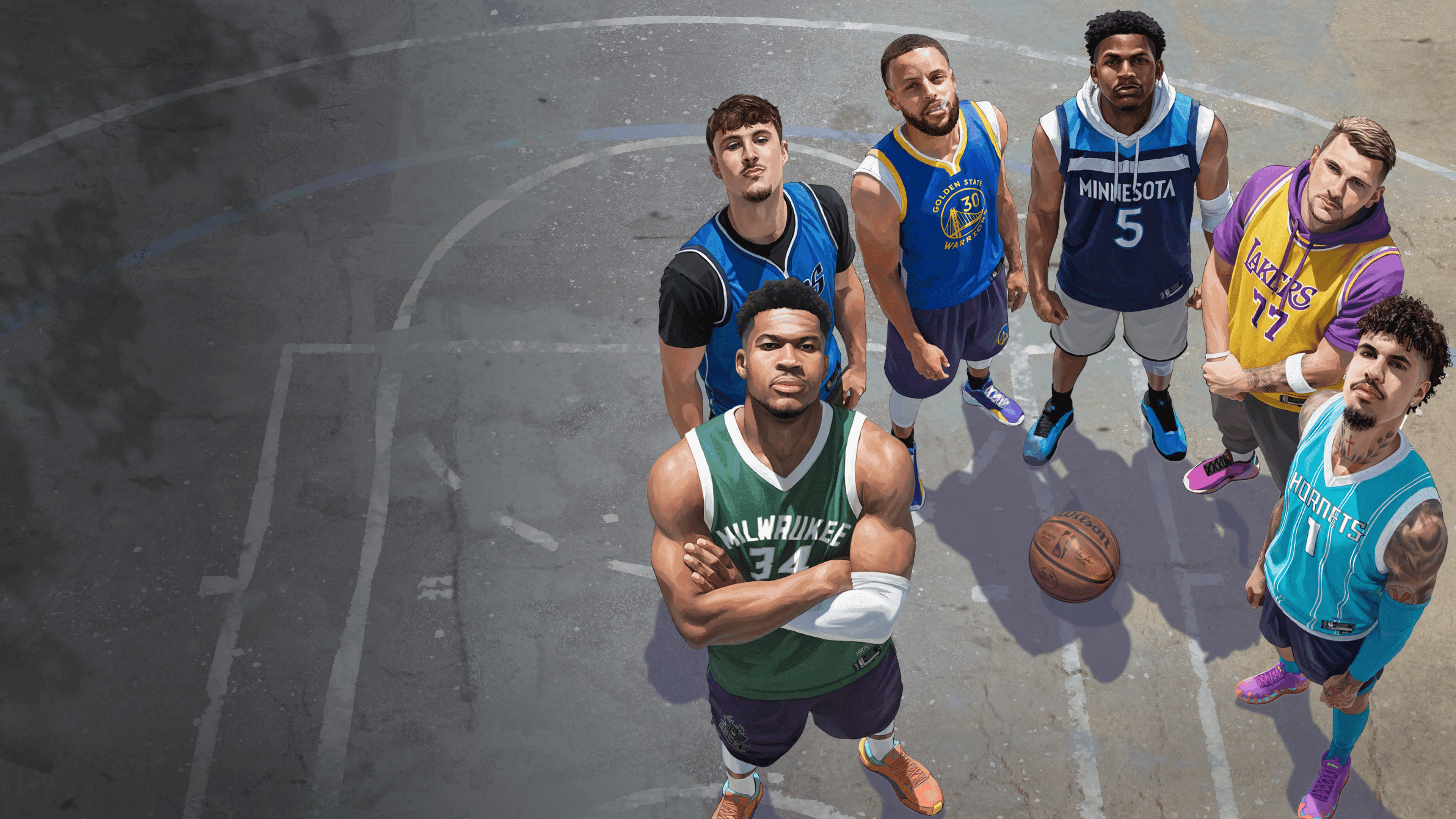
Take your favorite NBA stars to iconic streetball courts around the world, in this fast-paced, online 3v3 basketball game. Stack wins, earn cred and become the GOAT of THE RUN.
NBA The Run required a character pipeline built around a roster of 40+ real NBA players with several outfits each, body heights ranging from 188 cm to 224 cm and proportions that vary just as widely across wingspan, limb length, and torso ratio. Players are highly recognizable. We pitched and worked with engineers on a retargeting / outfit based system which required 70% less assets.
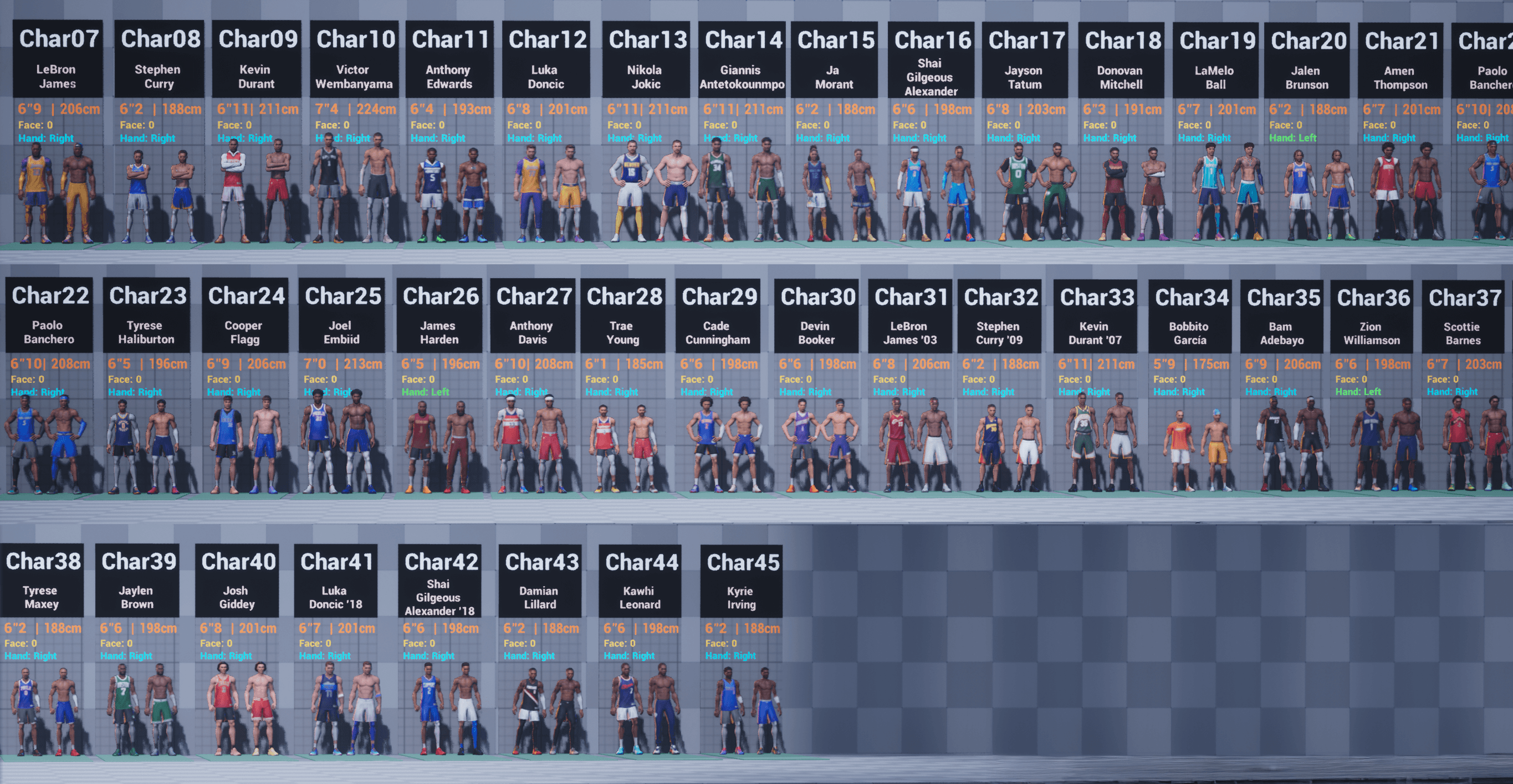
A 224 cm center cannot move like a 188 cm guard, and audiences notice immediately when proportions are wrong or when motion is retargeted poorly. The naive approach: Authoring animations per character which is difficult to scale. With a typical sports game animation set multiplied across the full roster, the authoring cost runs into thousands of assets.
The pipeline had to absorb a potential asset explosion without collapsing into uncanny retargeting artifacts. We standardized on a single reference skeleton and built the retargeting pipeline around Unreal's IK Rig and Control Rig.
Animators author animations on the base rig. The IK Rig stack handles per-character Full Body IK solving — preserving contact, foot planting, hand placement on the ball, and proportionally correct silhouettes across the height range. This allowed us to let animation or gameplay drive effectors, depending on the scenario and cutting down the required animations.
Unique animations handle per-character corrections and tuning passes where retargeting alone is not sufficient. Driving 40+ players from one set keeps the authoring cost constant as the roster scales, but these characters live on personality. The pipeline supports targeted authoring anywhere in the stack so the shared set carries the roster while authored work carries the character.
Rigs are generated through Puppet Factory, our in-house modular rigging system. Every character on the roster is a Puppet Factory build — joint-based body rig, joint-based face rig, volume-preservation correctives using our in-house system “VolBones”, and the deformation rig layer all generated from the same modular definitions
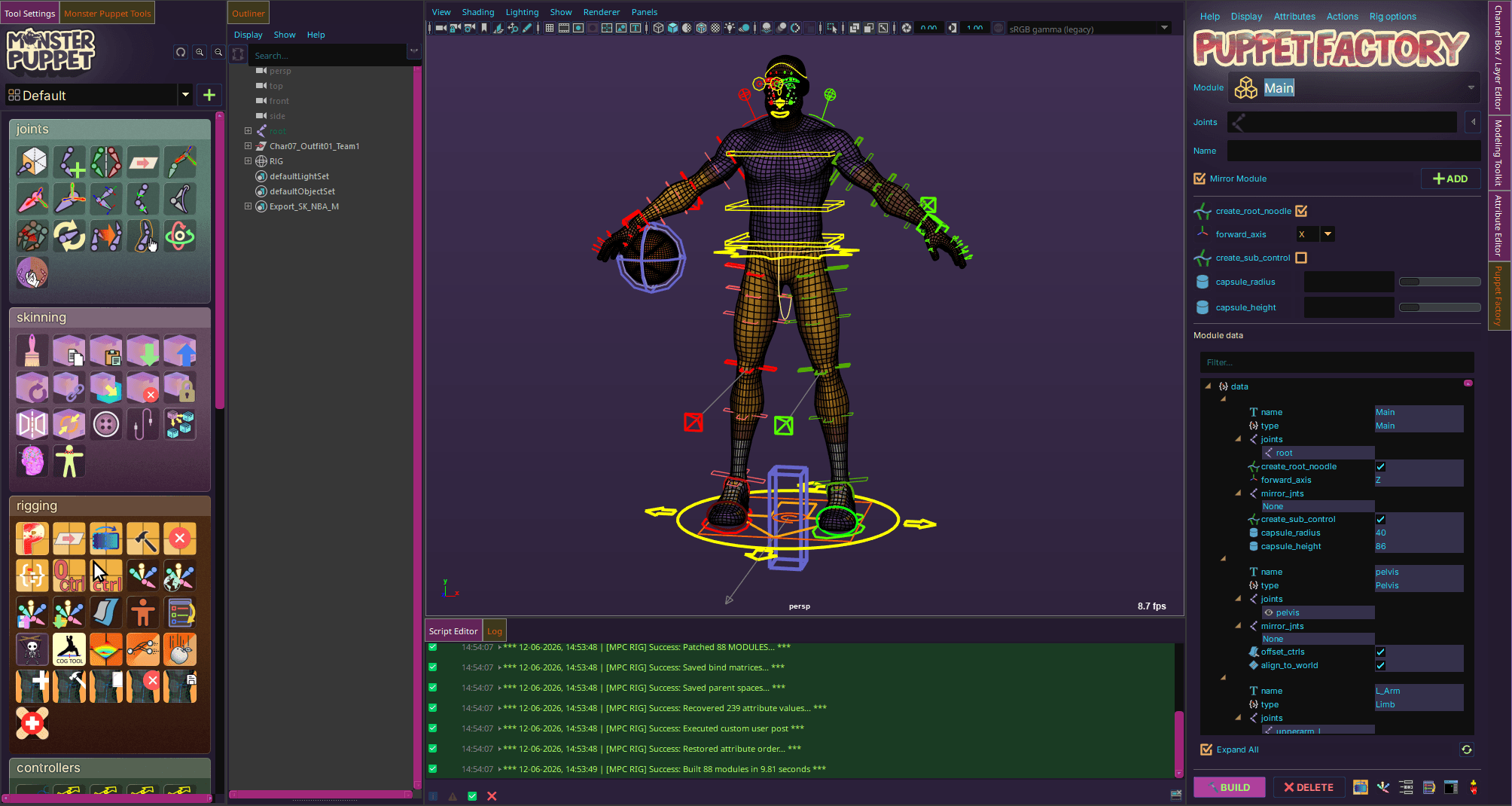
Modular construction is what makes a 40+ character roster scalable: rig changes propagate, fixes apply globally, and per-character variation lives in data rather than in hand-edited rigs. Skinning is supported by our internal toolset for weight transfer, propagation, and volume-joint setup. Cloth and secondary motion are a hybrid of simulated cloth and ragdrolled chains, tuned per garment.
The most pipeline-specific piece is how we handled cloth collision. Standard practice is to simulate the lower hem of a jersey or shorts and leave the rest skinned — cheaper, but the motion reads very stiff.
We wanted full-garment simulation without paying the cost of accurate body collision geometry.
The solution: bake clothing thickness into the mesh's vertex colors and use the various channels to drive things like max distance / backstop etc in the cloth solver. Cloth is allowed to move away from the body freely, but the baked thickness prevents it from intersecting back through it. With this, the entire jersey and shorts simulate and read as realistic full-garment motion rather than a flapping skirt under skinned cladding.
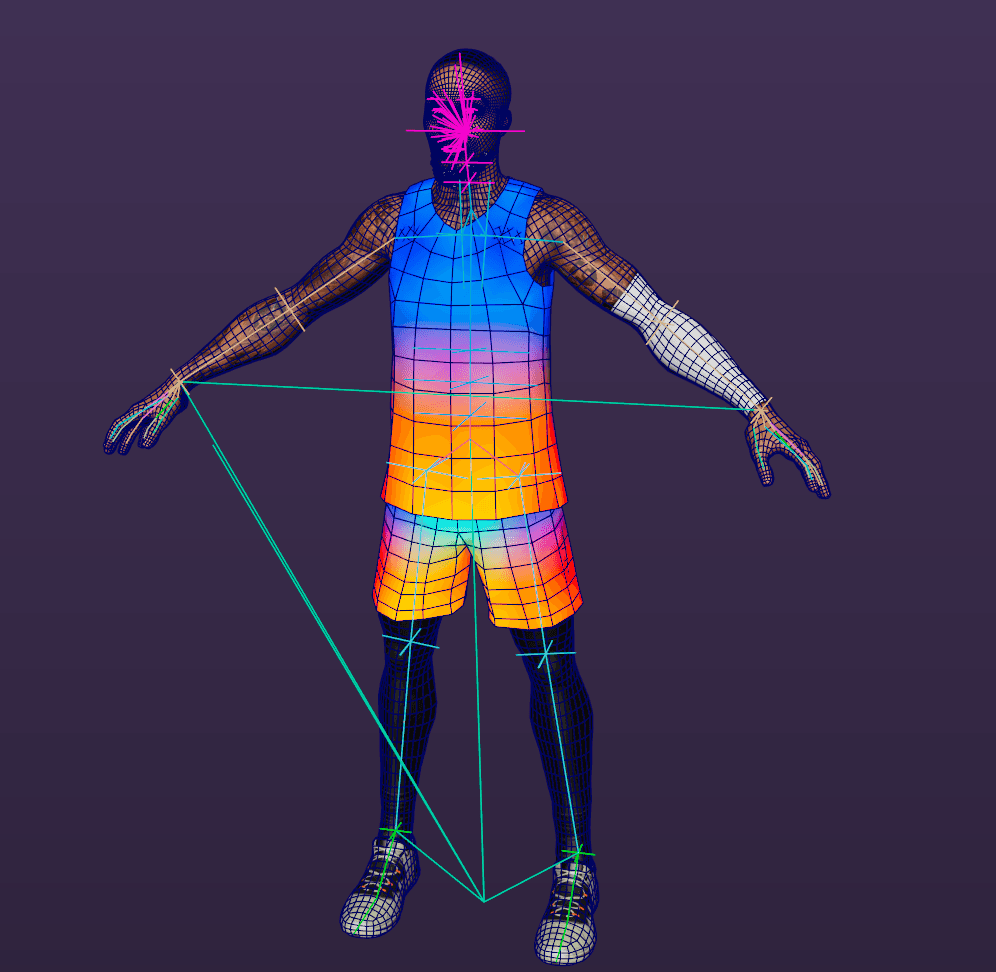
Layered garments (compression shirts under jerseys, base layers under shorts) stack with their own baked thicknesses.
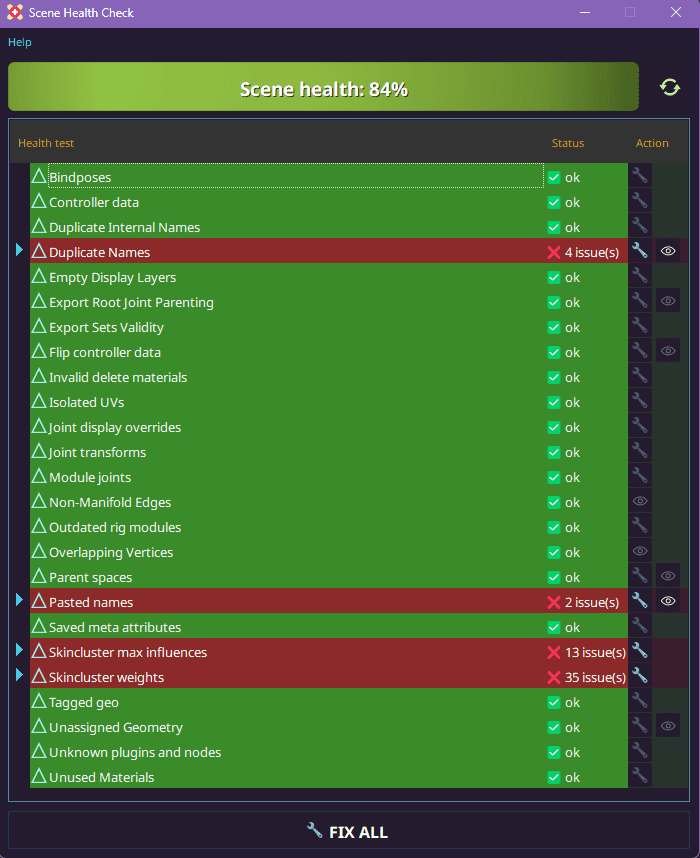
Validation is handled by our internal health tool, which checks rigs, skin weights, naming, hierarchy, and export integrity before anything leaves Maya. Export to Unreal runs through our custom mesh and animation exporters, which enforce the conventions the in-engine retargeting stack depends on.
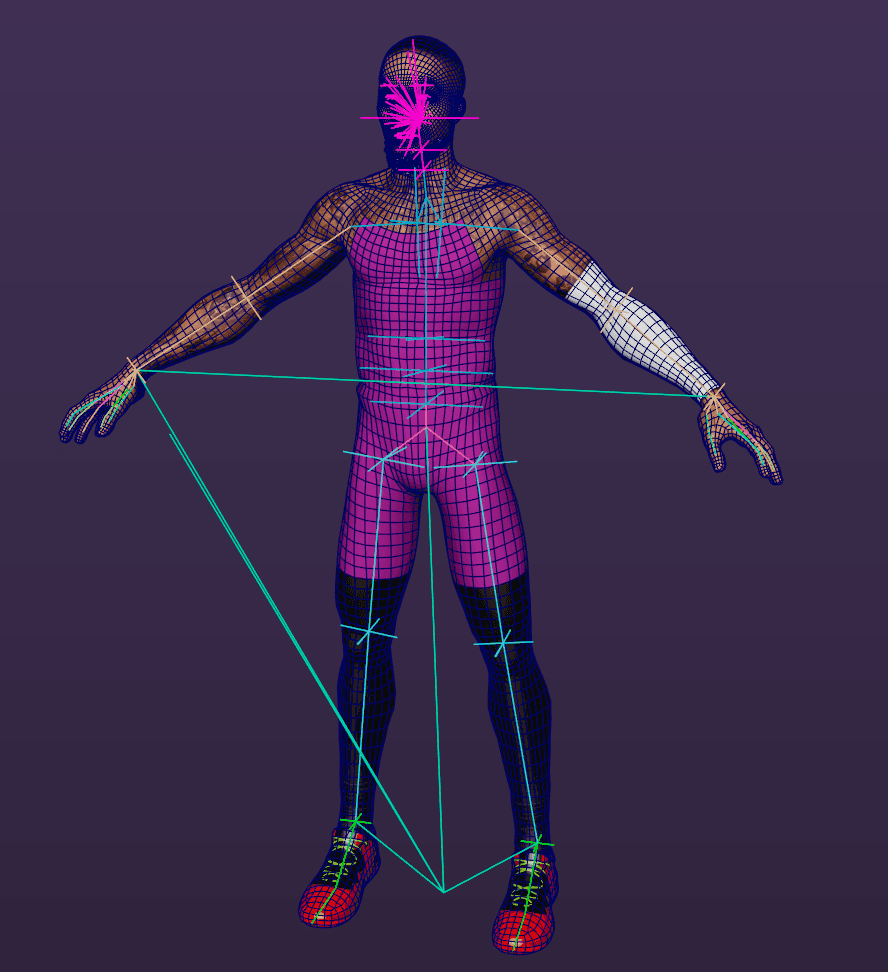
We also utilize a non-destructive system which automatically removes polygons the player would never see, since they are occluded by clothing, before export.
When Monster Puppet joined the team, we were in the process of converting our originally announced game THE RUN: GOT NEXT to the officially licensed game, NBA THE RUN.
As part of the process to convert over to NBA THE RUN, our ambitions for the project grew significantly and we aligned on one main goal - be the best looking and most fun basketball game on the market. In order to deliver on that goal, we engaged with the team at Monster Puppet to help build & execute the plan.We aimed to create hand-crafted, curated player characters that were both performant from a technical perspective and also unique at any given level of animation. This meant that we needed to create a system where our players were constructed on one core rig / skeleton (performance) while also providing the flexibility to feature unique animation(s) for every single playable character in the game.
Throughout the first few months, we worked hand in hand with the team at Monster Puppet to craft this plan - the MP team has been fully embedded with our core development team from Day 1, which has been key to our success. We built this plan alongside Engineers, Character Artists, Animators and Designers to ensure that we were all aligned and also confident that we would deliver a best in class system for our game. The bulk of the work came as we built the system and there was a lot of iteration. When you have a game that features characters from 5'7" to 7'7" all with the ability to technically run on 1 rig / skeleton while also featuring unique animations for any given move / moveset, there's quite a bit of work involved.
We've been working together for well over a year now and the team at Monster Puppet truly feel part of our core development team - they have worked with us from concept through to completion (and all of the iteration in between). When we ran into challenges, we figured them out together. When we had new design requests (such as a scalable rig for facial animations to bring more life to our characters), we put our heads together and figured it out. I'm proud to say that throughout this engagement, we have not only found a long-standing partner w/ Monster Puppet, we have found a team who fundamentally helped us achieve our goal of being the best looking and most fun basketball game on the market.
The Monster Puppet Team have been nothing short of phenomenal partners for us here at Play by Play Studios and we look forward to a bright future ahead, together. We Got Next.

Scott Probst, CEO
Play by Play Studios